
Fluvanna Projected Versus Actual Release
A projected date is a calculation based on facts known at that point. For a state prisoner, the Virginia Department of Corrections applies the sentencing orders, offense dates, jail credit, mandatory minimums, sentence structure, and the credit rules that govern each offense. The date may reflect credits the person could earn in the future. An actual release date records an event that has already occurred. It should be supported by a custody-status change, a VADOC discharge record, or a CVRJ release record rather than by an earlier forecast.
Pretrial custody works differently. Someone awaiting a Fluvanna court decision does not have a sentence-based release date. Release may depend on whether bond is granted and posted, whether a charge is dismissed, or whether another court or agency has placed a hold. A court order can authorize release, but CVRJ must still check the person’s full custody record before discharge. A transfer to VADOC, another jail, federal custody, or ICE ends CVRJ custody without returning the person to the community.
That distinction also applies when the VADOC locator changes location. Movement from Fluvanna Correctional Center for Women to Charlottesville District 9 can show a move from incarceration to community supervision. It does not mean the entire sentence or supervision term ended. “Parole” means conditional release while part of a sentence remains under supervision. “Discharge” means the relevant custody or supervision obligation has ended.
Find a Fluvanna Projected Release
Start with the sentence owner. Central Virginia Regional Jail is the usual adult jail for a Fluvanna arrest, even though the facility is in Orange. VADOC calculates state-prison terms, including sentences served at Fluvanna Correctional Center for Women. The court record explains what sentence was imposed. It does not perform the jail’s or VADOC’s final time computation.
The Fluvanna County Sheriff court-information page routes local jail questions to CVRJ, which is a separate regional authority. That division avoids sending a sentence-calculation question to an agency that does not own the record. The Fluvanna court remains useful for the sentence and bond history, while CVRJ supplies the local custody event and VADOC supplies a state computation.
- Check the Fluvanna court case to identify whether the person is pretrial, serving a local term, or committed to VADOC.
- For a state sentence, open the VADOC Inmate and Supervisee Locator and search with the DOC ID or name.
- Open the matching record. Copy the exact location, status, and release-date label rather than renaming the field.
- For a CVRJ term, call Central Virginia Regional Jail and ask which office can confirm the calculated date.
- If the public result is unclear, request the existing time-computation, release, or discharge record from VADOC or the CVRJ records custodian.
Search by the seven-digit DOC ID when it is known. Name searches require the full last name and at least the first three letters of the first name. Optional VADOC filters include location, race, gender, and age range. Compare the available details before relying on a match. For help separating a release forecast from a completed local custody event, the Fluvanna County released inmate search explains the court, jail, and state paths together.
Note: A missing VADOC result does not prove discharge because the locator is not a complete archive of every person once supervision ends.
VADOC Fluvanna Release-Date Search
The VADOC tool covers more than prison residents. It may return people in state institutions, people in local or regional jails under VADOC authority, probationers, parolees, institutional-hospital patients, and Community Corrections Alternative Program participants. A result at an institution points to custody. A district-office location points to community supervision. VADOC states that the locator updates daily and may contain information that is inaccurate or out of date, so it should not be treated as a live exit clock.
| Locator detail | How to read it |
|---|---|
| DOC ID | Use the seven-digit identifier to distinguish people with similar names. |
| Location or status | An institution and a community corrections district describe different forms of VADOC control. |
| Release-date value | If the displayed date is in the future, treat it as projected and preserve the exact field label. |
| Daily update notice | A same-day transfer, recalculation, or release may not yet appear. |
The interface does not promise that each record will show the same fields. A future value must not be reported as an actual discharge. If the record has changed from an institution to District 9, corroborate the move through VADOC records or the applicable notice. If no record appears after full discharge, the sentencing court and a VADOC records request are the sound historical fallbacks.
Virginia Credits Shape Fluvanna Release
Virginia’s truth-in-sentencing framework generally ended discretionary parole for felony offenses committed on or after January 1, 1995. Yet the common claim that each Virginia prisoner serves exactly 85 percent is wrong. The traditional cap of 4.5 earned sentence credits for each 30 days served yields about 86.96 percent if all such credits apply. Current law contains several categories, and some eligible offenses can earn credits at higher rates.
Virginia Code § 53.1-202.3 limits listed serious offenses to no more than 4.5 credits per 30 days. For other eligible offenses, the statute uses four levels. Level I provides 15 days per 30 served, Level II provides 7.5, Level III provides 3.5, and Level IV provides none. Classification may turn on statutory exclusions, conduct, program cooperation, work or education assignments, and correctional infractions. Mandatory minimum time is not reduced in the ordinary way. A single sentence history may contain offenses subject to different rules. Some older offenses remain within parole or older good-conduct systems. VADOC’s Time Computation unit must apply the actual orders, dates, credits, and concurrent or consecutive terms. That is why a rough percentage cannot produce a dependable Fluvanna County projected release date. The official VADOC Time Computation page shows the categories used in state sentence calculation.
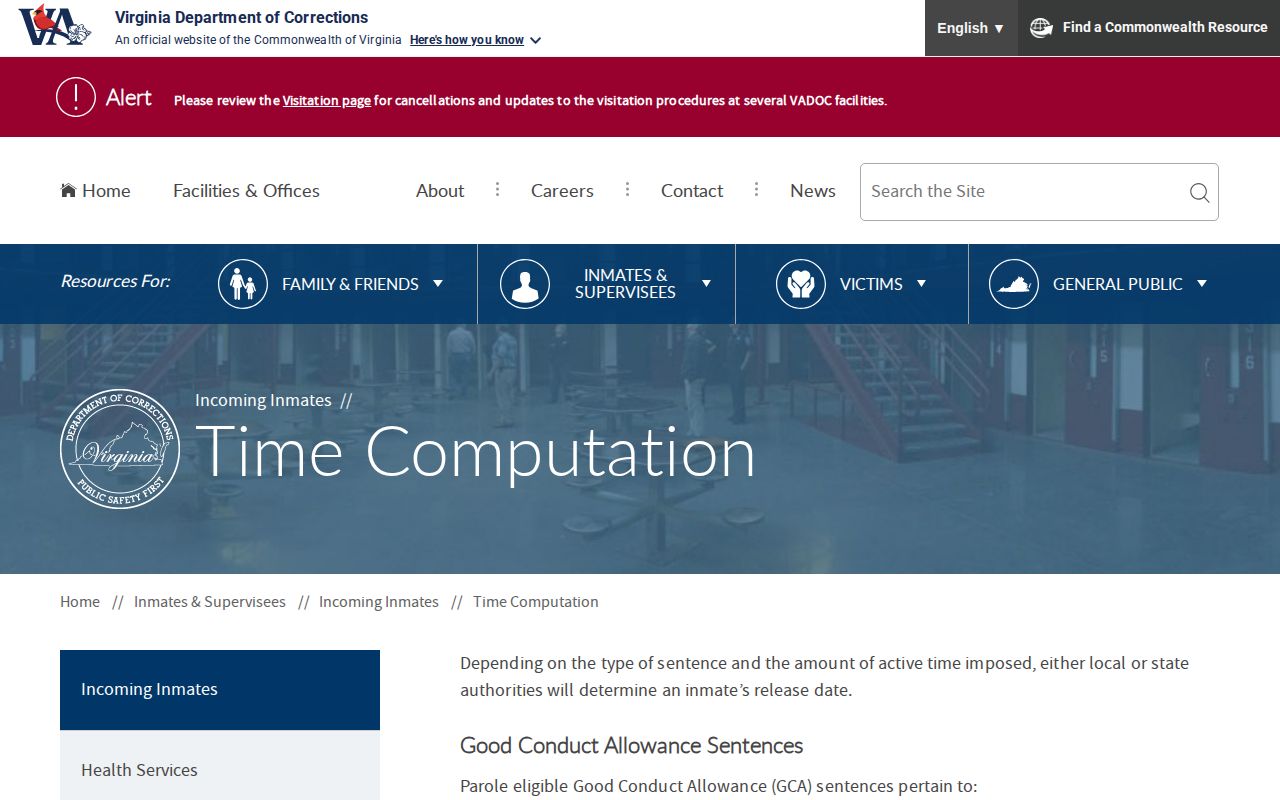
The captured agency page helps identify which computation questions belong with VADOC rather than CVRJ or the sentencing clerk.
Note: Earned credits affect the calculation, but they do not erase a separate detainer, mandatory minimum, or later sentencing order.
Fluvanna CVRJ Release Credits Differ
First ask who is computing the term. This is the key local wrinkle. Current Virginia Code § 53.1-116 requires a local or regional jail to maintain a written earned-credit policy. A qualifying person sentenced to 12 months or less for a misdemeanor, or a combination of misdemeanors, earns one day of good-conduct credit for each day served without a jail-rule violation. Mandatory minimums and conduct limits still apply.
The same statute provides a different rule for parole-eligible jail prisoners and permits added credit for institutional work, classes, or local workforce programs when those options exist under the written policy. Post-1994 felony confinement in a jail remains subject to the limits in the state earned-credit framework. Pretrial jail credit, partial days, consecutive sentences, rule violations, and other holds may also change the date.
- Local jail credit
- Credit applied by CVRJ to a qualifying local or regional jail term.
- Earned sentence credit
- Credit applied within the VADOC state felony framework.
- Mandatory minimum
- A part of a sentence that ordinary good-time credits cannot reduce.
- Detainer
- A request or hold that may keep a person in custody for another authority.
The announced court sentence is not an exact discharge timestamp. For a CVRJ sentence, the jail’s record is authoritative. No researched Virginia rule requires CVRJ to release every person early on Friday when a date falls on a weekend or holiday. Call the jail about a specific case rather than assuming an early-release practice.
What Changes Fluvanna Release Dates
A calculated date can move in either direction. Some changes correct the sentence information used at intake. Others reflect later conduct, a new order, or custody claimed by another authority. A public locator can also lag after the underlying calculation has changed.
| Factor | Possible effect on the date |
|---|---|
| Jail credit correction | Credit for time already served may be added or corrected. |
| Concurrent or consecutive terms | A corrected order can change whether terms overlap or follow each other. |
| Credit classification | Conduct, programs, statutory limits, forfeiture, or restoration can alter earned time. |
| New court action | An amended order, new sentence, or supervision violation can require recalculation. |
| Parole or conditional release | An eligibility or grant decision can affect the path, but a grant alone is not physical release. |
| Detainer or hold | Another agency may take custody even when the first sentence has reached its end. |
| Administrative update | The public display may trail VADOC’s internal record because the locator updates daily. |
Parole eligibility is especially case-specific. Virginia Code § 53.1-151 contains exceptions and older-sentence rules. A Virginia Parole Board grant starts release-plan and administrative work; it does not prove that the person has walked out of a facility. The current VADOC location and later custody event remain necessary.
Confirm Fluvanna County Release
Use the system that holds the person. For CVRJ, Virginia Jail VINE can report a release or transfer event, while the jail can address the actual release time and destination within its disclosure rules. A transfer event means custody continues elsewhere. If a state sentence follows, search VADOC after the handoff and allow for its daily update cycle.
For an FCCW or other VADOC case, qualifying victims use NAAVI rather than relying on a local Jail VINE registration. The Virginia Jail VINELink check is useful for a person-specific CVRJ event, but it does not carry a local-jail registration through an entire state-prison term. A VADOC record showing community supervision can confirm that incarceration ended while supervision continues.
Keep the date label, facility, status, event date, and identifier together. When durable proof is needed, request the agency’s existing release, discharge, or time-computation record. Court records explain the legal basis, while the custodian records the physical custody change. Those two sources answer different questions and work best as a pair.
For a local term, the CVRJ records-request channel is the documentary fallback. Describe the existing booking and release record with the person’s full name, known booking or case number, and the relevant dates. Ask for the actual release date and time, disposition, and receiving agency if the event was a transfer. A narrow request helps the custodian identify the record without being asked to create a new calculation or report.
Note: Never treat absence from a current roster or locator as proof that every agency has released the person.