
Fluvanna Parole Versus Probation
Virginia assigns decisions and supervision to different bodies. The Virginia Parole Board decides discretionary parole and certain revocations within its legal authority. VADOC Community Corrections supervises probationers, parolees, and other people placed under community control through district offices. A person can therefore appear in a Board decision, a court order, and a VADOC locator result, with each record describing a different step.
Parole is conditional release from incarceration on an eligible sentence. The person serves the remaining balance in the community under set conditions. Probation is ordered by a court and often accompanies suspended jail or prison time. It can begin without a VADOC prison stay. Neither status means the underlying case has vanished, and neither should be inferred from the fact that a person is no longer found in jail custody.
| Point | Parole | Probation |
|---|---|---|
| Source | Conditional release on an eligible sentence | Court-ordered community supervision |
| Decision record | Virginia Parole Board materials when applicable | Sentencing and probation terms in the court case |
| Supervising body | VADOC Community Corrections | VADOC Community Corrections |
| Public lookup | VADOC locator and Board reports | VADOC locator and court disposition |
| End point | Discharge after the authorized parole term ends | Discharge or termination under the governing order |
- Parole
- Conditional community release while part of an eligible sentence remains.
- Probation
- Court-ordered supervision in the community, often linked to suspended time.
- Supervisee
- A person whose community status is managed by a corrections district office.
- Absconder
- A person alleged to have stopped required contact or failed to comply with supervision.
- Discharge
- The formal end of the agency’s supervision status.
Verify Fluvanna Post-Release Supervision
The VADOC Inmate and Supervisee Locator is the main public check. It expressly includes probationers and parolees supervised by district offices, along with people in state institutions and several other VADOC categories. A result that lists a community district can show that incarceration ended while supervision continues.
- Gather the full name and seven-digit DOC ID when known. A DOC ID is the strongest way to distinguish similar names.
- Search by DOC ID, or enter the full last name and at least the first three letters of the first name.
- Use location, race, gender, and age-range filters only when needed to separate matches.
- Open the matching record and copy the exact status, location, and release-date label instead of paraphrasing them.
- If the result names District 9 or another district, treat that as community supervision, not jail or prison placement.
- Compare the result with the court disposition or Parole Board record, then contact the correct district when the person concerned needs officer instructions.
The locator updates daily and warns that its information may be inaccurate or out of date. It is not a real-time warrant system or a permanent archive of every discharged person. A no-result might mean the record uses another spelling, has not updated, belongs to a different system, is restricted, or no longer reflects active VADOC custody or supervision.
The official VADOC interface documents its search inputs and update warning:
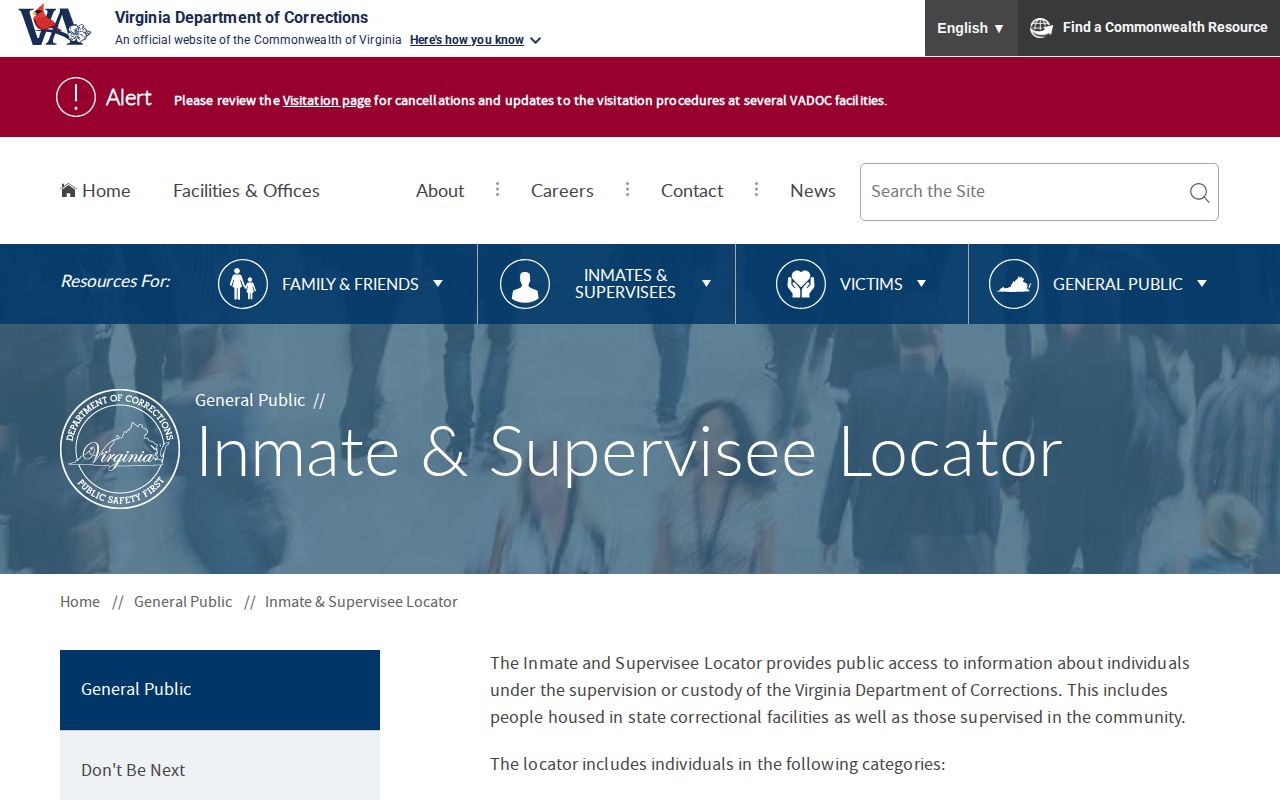
Read the displayed office as a supervision location. It does not prove residence at that office and does not turn a supervisee into an incarcerated person.
Fluvanna Supervision at District 9
Fluvanna County has no separate VADOC probation office in the official directory. Charlottesville District 9 serves Fluvanna, Albemarle, Goochland, Louisa, and Charlottesville. A locator result can therefore name Charlottesville even when the person lives in Fluvanna County. That office label is not proof of confinement or Charlottesville residence.
VADOC Community Corrections, District 9
750 Harris Street, Suite 202
Charlottesville, VA 22903
434-295-7194
Use the live VADOC facilities and offices directory to recheck the address before a visit. Office staff may limit disclosure of case details. A useful public question is whether the locator’s office information is current. The person under supervision should use the office channel to learn how to reach the assigned officer and comply with instructions.
The directory image shows FCCW and Charlottesville District 9 within the same statewide system:
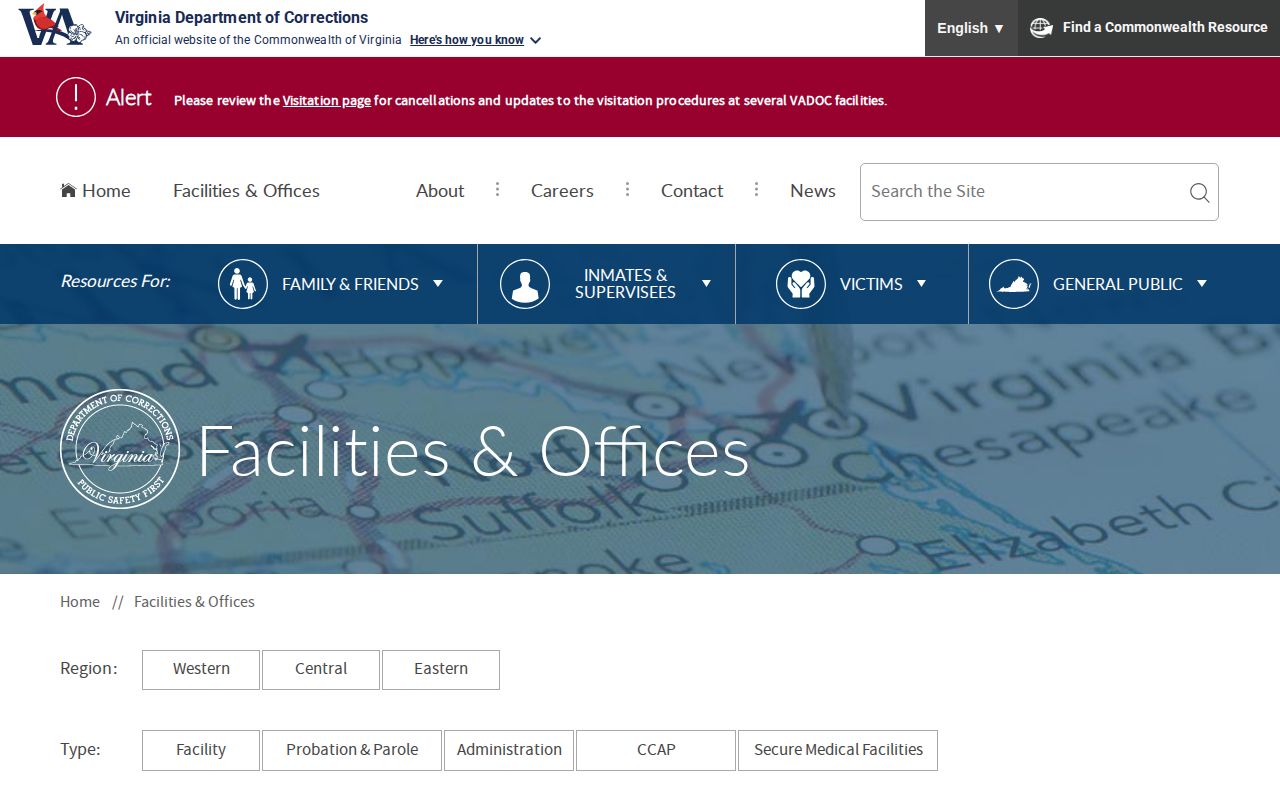
This pairing helps explain why a person may move from a Fluvanna prison location to a Charlottesville community office without entering a Charlottesville jail.
Note: The approved release residence may place supervision in another district, so follow the office named on the current VADOC record.
Fluvanna Parole Board Decisions
The Virginia Parole Board public-meetings page is the closest current calendar. It posts upcoming meeting information, agendas, a live-meeting link, and past minutes. The schedule is event-based, not a fixed weekly or monthly timetable. Since July 1, 2024, the Board says it must hold a public meeting for final deliberation and a vote when considering whether to grant parole, with victim participation allowed, but not every parole-eligible person receives a public meeting.
The monthly decisions archive is the public results route. A report can include review type, decision date, grant or not-grant result, reasons, votes, and conviction or sentence details. Search the likely month and adjacent months. Then verify current custody or supervision in VADOC because a Board report captures a decision, not every later step.
| Board term | Careful reading |
|---|---|
| Grant | Approval for conditional release, still subject to a plan and release processing |
| Not Grant | Denial at that review, not proof of current location or a lifelong bar |
| Deferred or reconsidered | The review timing or decision process continues |
| Revoked or rescinded | A prior community-release status may be withdrawn; verify custody with VADOC |
Virginia largely ended discretionary parole for felonies committed on or after January 1, 1995. Section 53.1-151 governs eligibility and contains many exceptions and special categories. No eligibility date should be calculated from its first general rule alone. Juvenile-offense and geriatric conditional-release provisions, offense dates, and sentence history can change the analysis.
Fluvanna Parole Grant Versus Release
A grant does not show that the person has physically left prison. The Board describes a later stage in which a plan is developed, required notice occurs, and release proceeds under policy. The VADOC location and status provide the better evidence of the actual transition. For a person at Fluvanna Correctional Center for Women, a change from the institution to a community district is more probative of the completed movement than the grant date by itself.
Victim notifications also split by custody system. Virginia Jail VINE covers CVRJ and other local or regional jails. Qualifying VADOC prison notifications use NAAVI. A VINE registration tied to a Fluvanna arrest does not automatically track a later state-prison term. VADOC Victim Services is the channel for questions about state notifications.
Does parole mean the sentence is over? No. Parole is conditional release under supervision for the balance governed by the sentence and parole authority. Discharge is the later end of that supervision status.
Fluvanna Supervision Violations and Warrants
Supervision conditions are case-specific. At a high level, they can require regular contact, compliance with lawful instructions, approved residence or travel, and other terms set by the court, Board, or VADOC. The public court summary or locator does not reveal every condition, and office staff may protect nonpublic case details. The supervised person should obtain instructions from the assigned officer rather than rely on a third-party summary.
VADOC has a Most Wanted page for selected fugitives, but the research does not support treating it as a complete list of every alleged parole or probation violation. Neither the Fluvanna County Sheriff nor CVRJ publishes a verified, comprehensive county parole-absconder list. “Absconder” describes an alleged failure to maintain contact or comply. It does not erase the earlier release and is not itself a new conviction.
A suspected warrant calls for current official confirmation. A court docket can show a revocation proceeding or related order when public. VADOC can show a change in status after it updates. Virginia Jail VINE can report a new local-jail custody event if the person returns to a participating jail, but it is not the main source for community-supervision conditions.
Note: A selected-fugitive page is not a full county warrant index, and absence from it does not settle a person’s legal status.
Fluvanna Reentry After Release
Central Virginia Regional Jail operates across county lines and maintains a reentry page linked to resources for its member localities. VADOC’s District 9 community-resource directory includes Fluvanna County agencies. This regional structure reflects how a person may leave a jail in Orange, live in Fluvanna County, and report through a Charlottesville office.
Reentry contacts support the move back into the community. They do not confirm the release event, the release time, or the supervision office. First verify a CVRJ release through VINE or the jail, or a state-prison transition through VADOC. Then use the directory tied to the approved release area. This order avoids confusing a helpful resource listing with an official custody record.
Correct Fluvanna Supervision Records
A supervision record can draw from several owners. VADOC controls its locator and Community Corrections records. The Parole Board controls its decisions and reports. The Fluvanna court clerk controls the court docket and sentencing record. CVRJ controls its own release timestamp and disposition. Send a correction request to the office that created the disputed entry.
Virginia Code § 9.1-132 gives an individual a process to inspect and challenge the completeness or accuracy of that person’s state criminal-history information. It is not a single correction desk for every court, jail, Board, and VADOC record. Separate the source records before seeking a change, and keep identifiers that tie each entry to the correct case.
If the issue concerns a release event rather than supervision, the Fluvanna County released inmate search and record process identifies the appropriate jail, court, state, and federal custody paths.
Ending Fluvanna County Supervision
Community supervision ends through the authority governing the case. The end can appear as a discharge or termination in an agency or court record. It is distinct from release from jail or prison. A person may have left incarceration long before the supervision term ends, and the VADOC locator can continue to return a community-office location during that period.
To verify the end, save the last matching VADOC status, compare it with the court order or Board authority, and seek an existing discharge record from the proper agency if durable proof is needed. A no-result in the locator does not by itself establish discharge because the tool warns of delay and does not promise a universal archive. The latest official record should state the end of supervision rather than leave it to inference.