
FCCW Release and Transfer Paths
Fluvanna Correctional Center for Women is operated by the Virginia Department of Corrections, or VADOC. It is in Troy within Fluvanna County, but it is not the local jail. The women held there are state prisoners whose cases can come from jurisdictions throughout Virginia. A Fluvanna County arrest remains a regional-jail matter unless VADOC later assumes state authority.
Leaving FCCW can mean release from incarceration to the community, parole where legally available, transfer to another VADOC institution, movement to a hospital, or another state-custody event. A transfer does not end incarceration. A move from FCCW to a VADOC Community Corrections district can show that confinement ended while probation, parole, or another supervision status continues.
Confirm an FCCW Release
The official VADOC Inmate and Supervisee Locator covers state institutions and community supervision. It also includes people in institutional hospitals, certain people in local or regional jails under VADOC authority, and CCAP participants. This scope lets the same tool show a person at FCCW and later at a supervision district.
- Search with the seven-digit DOC ID when known. It is the clearest match key.
- For a name search, enter the full last name and at least the first three letters of the first name.
- Use location, race, gender, or age-range filters if they help distinguish people with similar names.
- Open the matching record and copy the exact status, location, and release-date label displayed.
- Treat a future release date as projected. Confirm actual movement through the resulting location, VADOC records, or the proper notification.
- If the location changes to District 9 or another district, read it as community supervision rather than incarceration at that office.
VADOC says the locator updates daily and may contain inaccurate or outdated information. It is not a real-time gate log and does not promise a universal archive of every fully discharged person. If a person no longer appears, use the sentencing court and VADOC records rather than treating the blank result as proof.
FCCW Offender Search Fields
Search inputs and record details serve different roles. The inputs help identify the right person. The result’s exact location and date label help determine whether the record points to incarceration, projected release, or community supervision. Never convert a field labeled only “Release Date” into an “actual discharge date” without checking whether the value is in the past and whether the location changed.
| Field | Use | Limit |
|---|---|---|
| DOC ID | Seven-digit direct identifier | Must match the correct person |
| First and last name | At least three first-name letters plus full last name | Can return similar names |
| Location | Shows institution or community office when displayed | May lag a same-day move |
| Release-date value | Provides the date shown by VADOC | A future value is projected |
| Demographic filters | Race, gender, and age range can narrow results | Use only to identify the correct record |
A result located at FCCW supports current state-prison custody as of the reported update. A result at a Community Corrections office supports supervision outside prison. A no-result can reflect spelling, delay, restrictions, a different custody system, or full discharge from the locator’s active population.
Note: Save the exact VADOC label and update context; one date can be projected before release and historical only after corroboration.
FCCW Records and Contact
The facility contact can route institution-specific questions, but public release status begins with the locator. VADOC central records is the formal route for an existing time-computation, transfer, release, or discharge record. Include enough identifiers to prevent a false match and describe the existing record rather than asking staff to create a legal explanation.
Fluvanna Correctional Center for Women
144 Prison Lane
Troy, VA 22974
434-984-3700
VADOC Central
P.O. Box 26963
Richmond, VA 23261
804-674-3000
Use the VADOC FOIA process for agency records. Give the full name, DOC ID, facility, date of birth when lawfully available, and relevant dates. Request the existing time-computation, movement, release, or discharge record. Privacy, safety, and security restrictions can lead to redaction or withholding.
About Fluvanna Correctional Center
FCCW is a women’s state correctional institution. Its Troy address places the building in Fluvanna County, but geography does not convert state prisoners into county-jail detainees. The VADOC facilities and offices directory is the official source for the facility and the community office serving Fluvanna County.
The state directory shows both FCCW and Charlottesville District 9:
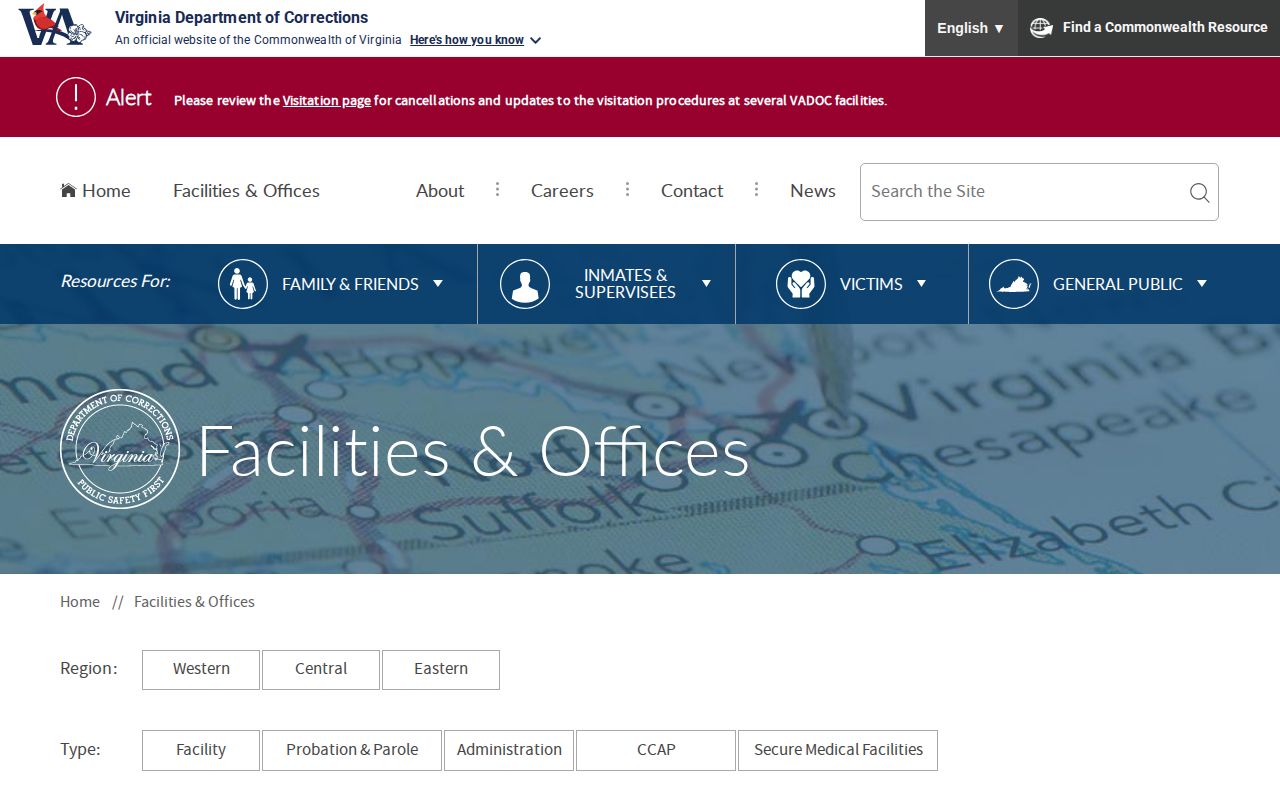
This statewide structure matters after release. A woman can leave FCCW and appear at District 9 or another approved supervision office while still under VADOC authority.
A woman arrested in Fluvanna County may instead be booked at Central Virginia Regional Jail. That is a local or regional custody path. FCCW becomes the relevant source only when VADOC authority and placement point to the state institution. Keeping the two systems separate prevents a county court location or prison address from being mistaken for the actual custodian.
FCCW Projected Release Dates
VADOC computes state release dates from the judgment orders, offense dates, jail credit, consecutive or concurrent terms, mandatory minimums, parole eligibility where applicable, and earned sentence credits. The public locator may display a release-date value. If that date is in the future, it is a calculated projection rather than a promise of the final day or hour.
Virginia Code § 53.1-202.3 uses different credit rules. Listed serious offenses can be limited to 4.5 days per 30 days served. Other eligible offenses can fall into four levels: 15, 7.5, 3.5, or zero days per 30 served. Mandatory minimum portions and statutory exclusions impose further limits. A sentence can contain counts governed by different rules, so one percentage cannot reliably calculate every FCCW release.
Projected dates can change after corrected orders, jail-credit changes, consecutive or concurrent sentence review, a new sentence, forfeiture or restoration of credits, a classification change, parole or revocation action, a detainer, or routine data lag. VADOC’s Time Computation unit applies the governing documents and law. The Fluvanna County projected release date page covers these calculations in detail.
FCCW Release to Supervision
Fluvanna County is served by VADOC Community Corrections District 9 in Charlottesville, but a person’s approved residence can place supervision in another district. A locator result that names Charlottesville therefore does not show incarceration in Charlottesville. It identifies the community office managing the public supervision status.
VADOC District 9 Charlottesville
750 Harris Street, Suite 202
Charlottesville, VA 22903
434-295-7194
Probation and parole are not interchangeable. Probation comes from a court order and can follow suspended time without a state-prison stay. Parole is conditional release on an eligible sentence and is decided by the Virginia Parole Board within its authority. Both can be supervised by VADOC Community Corrections. Discharge from supervision occurs later and should be verified through the governing record.
FCCW Parole Decision Records
Virginia largely abolished discretionary parole for felonies committed on or after January 1, 1995, though older and special categories remain. The Virginia Parole Board publishes public-meeting information and monthly decision reports. A report can show a grant, not-grant result, reasons, votes, decision date, and conviction or sentence details.
A grant is not the physical release event. The Board describes later release-plan and processing steps. Compare the decision with the VADOC location and status. “Not Grant” describes that review, not a permanent bar or the person’s present location. A deferred, reconsidered, revoked, or rescinded entry also needs its own reading and current VADOC confirmation.
- Grant
- Approval for conditional release, still subject to required processing.
- Not Grant
- Denial at that review, without proving later status.
- Parole
- Conditional community release under supervision.
- Discharge
- The formal end of the applicable custody or supervision status.
FCCW Release Notifications Through NAAVI
Virginia separates jail and state-prison notifications. Virginia Jail VINE covers local and regional jails such as CVRJ. Qualifying registered victims in VADOC state-prison cases use NAAVI. A VINE registration made for a person at CVRJ does not automatically continue through an FCCW sentence after VADOC assumes custody.
The VADOC notification page is the official state-prison route. VADOC Victim Services can be reached at 1-800-560-4292 for registration assistance. Notifications support awareness of expected or completed events, but a projected notice is not the same as an actual discharge record. Keep the event details and confirm the resulting VADOC status when the distinction matters.
Note: NAAVI is the state-prison channel for qualifying cases; local Jail VINE remains a different system tied to participating jails.
FCCW Release Records and Photos
A focused VADOC request can seek the existing time-computation, release, transfer, or discharge record. Ask for the exact release-date field, whether it was projected or actual at the relevant time, the movement destination, and the supervision office when those fields exist and are releasable. VADOC can redact information protected by privacy, security, or other law.
A VADOC locator profile may display an offender image depending on the record and current interface. That image is a state corrections identification image, not the CVRJ booking photograph from an earlier local arrest. If a county booking photo is needed, identify the jail or arresting agency that created it. Do not ask the Fluvanna Sheriff to supply an FCCW release record it does not own.
For durable verification, pair the VADOC record with the sentencing court order or Parole Board decision when applicable. The court explains the sentence. VADOC documents custody, computation, movement, and community supervision. The Fluvanna County released inmate search separates these state records from local-jail and federal paths. Together the sources avoid treating a planned date or old photograph as proof of a completed release.