
Fluvanna Federal BOP Release Path
The Federal Bureau of Prisons is a national prison system, not a Fluvanna County facility. No federal prison has been identified within the county. The BOP path becomes relevant only when a person has a federal prosecution, federal sentence, or transfer into BOP authority. A Fluvanna County arrest handled in state court does not become federal merely because the person later leaves Central Virginia Regional Jail.
A person can leave a BOP institution because of release from incarceration, transfer to another federal institution, movement to a residential reentry setting, court action, or delivery to another custodian. The BOP result must be read for both release date and location. A past date paired with location “RELEASED” means the person is no longer in BOP custody. It does not prove that every form of supervision or every other jurisdiction’s custody has ended.
The local distinction is sharp. The Fluvanna County Sheriff and courts hold local arrest or case material, while CVRJ holds its jail event. BOP holds the federal prison record. Identifying the custodian first prevents a county release and a federal discharge from being merged into one event.
Search BOP Records for Fluvanna
The official BOP Inmate Locator supports two search routes. A person can be searched by name with available age, race, and sex filters, or by a known federal identifier. Identifier searches can use a BOP register number, DCDC number, FBI number, or INS number. Exact identifiers are usually the safer way to separate people with similar names.
- Open the BOP locator and choose a number search when a federal identifier is known.
- For a name search, enter the person’s name and use only supported filters that can be matched with confidence.
- Compare the full result, including name, register number, age, race, sex, release date, and location.
- Read a future release date as projected. Read “UNKNOWN” as an undetermined confinement term.
- When the date is past, confirm that the location says “RELEASED” before reporting the person out of BOP custody.
The official locator screenshot shows the federal search modes available for a Fluvanna-related federal record.
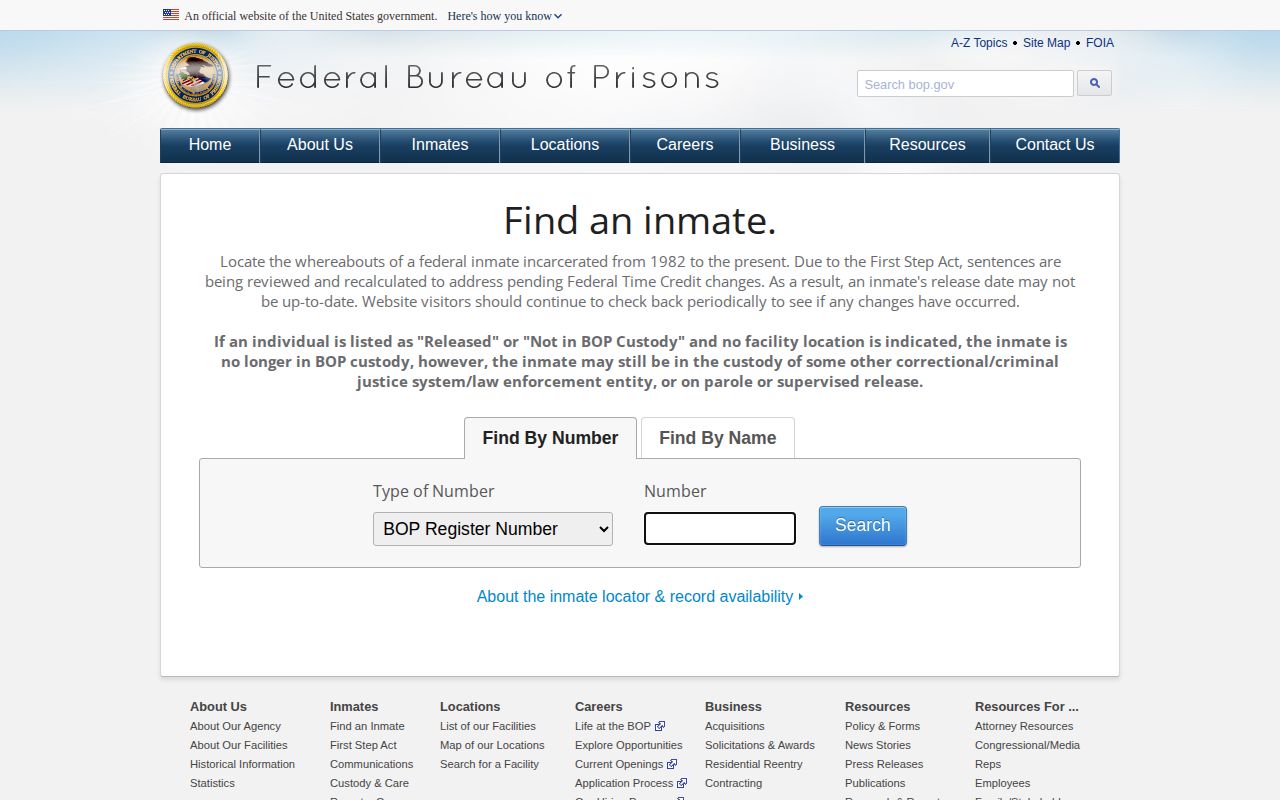
The source image helps distinguish a federal number search from a name search and keeps the lookup within the federal system.
Note: The BOP locator is not the correct source for an ordinary Fluvanna state prosecution or a person held only by CVRJ.
Read a BOP Released Result
A result is meaningful only when its fields are read together. A name match without the register number can point to the wrong person. The release-date field may describe a past event, a future projection, or an undetermined term. Location gives the needed context.
| BOP field | What it establishes |
|---|---|
| Name | The federal record’s identifying name, which should be checked against other known identifiers. |
| Register number | The BOP identifier used to distinguish the record from similar names. |
| Age, race, and sex | Comparison details supplied by the locator, not proof by themselves. |
| Release date | A past event when paired with RELEASED, or a projected date when it lies in the future. |
| Location | The named institution or the status “RELEASED.” |
| UNKNOWN | The confinement term has not been determined in the locator record. |
The BOP locator record guide explains that a past release date with location “RELEASED” means the person is no longer in BOP custody. That statement has limits. It does not rule out federal supervised release, parole in an applicable case, state custody, local custody, or immigration detention. Confirm the next status when the reason for the search depends on where the person went.
USMS Custody Before BOP Placement
The U.S. Marshals Service handles many federal pretrial custody movements. A federal defendant may be housed in a contract jail rather than a BOP prison. That person can be moved or released by federal court action without ever developing a conventional long-term BOP prison record. A blank BOP search therefore does not prove release.
When the person was detained before federal sentencing, identify the federal case and the actual holding facility. Use the federal court docket and authorized case contacts for the legal action. Contact the named jail for the physical custody event within its disclosure rules. If CVRJ was used for a federal hold, its record may show transfer to USMS or another federal destination rather than community release.
Do not substitute a Fluvanna state court search for a federal docket. Likewise, do not treat a person’s absence from the CVRJ information path as proof of freedom. A transfer from CVRJ to USMS ends the regional jail’s custody while federal custody continues.
Note: USMS contract custody can create a valid federal detention path even when the person never appears as a sentenced BOP prisoner.
BOP Federal Release Records
The BOP locator is the quick public route. It also acts as a historical source for many people released from federal prison after 1982. Earlier federal custody may fall outside that online coverage. The BOP record guide directs older inquiries toward the National Archives, using the person’s name, birth or age information, race, and approximate imprisonment dates to help identify the file.
Federal Bureau of Prisons
No BOP prison is located in Fluvanna County.
Local Custody Check
Central Virginia Regional Jail
13021 James Madison Highway
Orange, VA 22960
540-672-3222
A durable federal release inquiry should preserve the person’s register number, exact result fields, and search date. For a past result, save the release date and RELEASED location together. If the result does not cover the event, follow the BOP record guide rather than asking the Fluvanna Sheriff to produce a federal prison record it does not hold.
The historical boundary is about BOP records, not every kind of federal detention. Searchable coverage principally reaches people released from federal prison after 1982. Someone held only for the U.S. Marshals Service before trial may still require the federal docket and the contract facility, even when that detention was recent. For an older sentenced person, follow the BOP guide’s National Archives route with the best known identity and imprisonment facts. In each case, keep the court action separate from the physical custody record.
This boundary matters in Fluvanna cases because a county connection does not show which federal agency created the detention record.
After BOP Custody Ends
Leaving BOP custody does not always end the federal case. A court may impose supervised release, which is a period of community oversight after incarceration. A person can also enter state, local, or immigration custody because of another case or hold. The BOP locator reports BOP status. It is not a universal statement about every custodian.
The release destination controls the next check. If the federal judgment includes supervised release, the federal court record and the responsible federal supervision office explain that status. If a state or local detainer was executed, search the named state corrections system or jail. If ICE assumed custody, use the official ICE locator while its coverage applies. A BOP RELEASED result should never be rewritten as “free of all custody.”
- Release
- The end of BOP incarceration shown by a past date and RELEASED location.
- Transfer
- Movement to another institution or custodian, with custody continuing.
- Supervised release
- Federal court-ordered community oversight after incarceration.
- Projected date
- A future planning date that has not yet become an actual release event.
The Fluvanna ICE custody page covers the separate federal civil locator and its shorter released-record window. That path applies only when immigration custody is indicated.
Separate Fluvanna and BOP Records
Fluvanna County’s local structure can obscure a federal movement. The Sheriff handles local arrest and transport context, CVRJ is the usual adult regional jail, and the Fluvanna courts handle Virginia cases. None of those offices is the Bureau of Prisons. The Fluvanna Sheriff court and jail contacts can help identify the local side of a case, while BOP remains the federal prison source.
If a record begins with a Fluvanna arrest, use the Fluvanna County released inmate search to establish whether CVRJ reported release, transfer, or continuing custody. A transfer to USMS is not a community discharge. Once BOP authority appears, switch to the federal locator and keep the register number with the result.
For an existing CVRJ record, use the regional jail records channel. For a federal prison record, follow BOP. For the final legal outcome, follow the correct court. Matching these owners produces a sound custody timeline without forcing one agency’s search to answer a question outside its system.
A negative BOP search should trigger that custody check, not end it. Recheck the identifier, determine whether USMS held the person before sentencing, and review any named transfer destination. If the federal locator later shows RELEASED, compare its date with the jail transfer and court entries. Different dates can all be accurate because they mark separate steps in the same case.
Note: A federal release date and a Fluvanna jail release date can describe different custody events in the same person’s case history.